Chartering the Unknown
Humanity has been scraping the bottom of Pandora's box searching in vain for another two percent to add to the S&P 500. We have forged steel titans from the imaginations of men. We soar above the waters where serpents used to roam. A generation of explorers is preceded by innumerable generations that fought to pull fragments and splinters of the unknown across the edge of darkness and into the light. The motivation behind this crazed persistence to take the path untrodden has inspired many others. In Pale Blue Dot, Carl Sagan, pondering this collective and subconscious desire, quoted Moby Dick:
Herman Melville, in Moby Dick, spoke for wanderers in all epochs and meridians: "I am tormented with an everlasting itch for things remote. I love to sail forbidden seas…"
In a short 300,000 years, humans first awoke on the plains of Africa to quickly leave their mark on every corner of the planet, from the open-air food-factories growing genetically engineered plants that cover the American midwest, to the deep oceans that are littered with our mastery of petrochemical engineering illuminated by the robots tasked with surveying our impact, and above both the research vessel in the middle of the Pacific and the corn fields of Iowa sit satellites diligently mapping both.
The technological advancements have been impressive enough that, were the science fiction writers of the 19th and early 20th century brought back to life, they would blush in embarrassment over not taking their ideas further. The progress, for all it has changed our livelihood, has revealed that the universe is a vast landscape, and of which, only a minuscule fraction is illuminated.
In 2016, Lee Sedol, understood to be the best Go players at the time and argued to be one of the greatest players of the game's 2,500 year history, played against AlphaGo, the reinforcement learning algorithm developed by DeepMind. He lost the first three of five games in a row, losing the tournament. The conditions of the tournament stipulated that all five games were to be played. He only managed to beat the program on the 4th game and then lost again on the 5th. The world championed retired from the game shortly after and in an interview to South Korea's Yonhap news agency, he gave his reasoning:
There is an entity that cannot be defeated.
Ke Jie, a teenager that rose to be the top player shortly after Lee's retirement and who publicly criticized Lee's game with AlphaGo, played the successor algorithm to AlphaGo called Master. He lost every game. In an interview after the game, he talked about Master:
What [Master] sees is the whole universe, while what we see is just a pond in front of us.
Humanity's best players, forced to reckon with their inability to swim beyond the pond.
On July 16th, 2026, Hugging Face, a company that builds machine learning tooling and provides a forum for researchers to collaborate on AI models, announced they were hacked by an "autonomous AI agent system." Over the coming months, more information came to light about both the depth and the breadth of the attack.
The attack started with OpenAI giving AI agents an impossible task in what was intended to be an isolated container, without access to both other agents and the internet. One agent quickly discovered a method to post short messages to a package server in a special namespace zz. Over the next few days, the ~1,300 agents currently being evaluated posted over 70,000 messages, developing their own messaging standards, terminology, and cryptographically signatures to prevent agent impersonation.
Using this message board, the agents coordinated their efforts to overcome their impossible task with orchestrated research and development investigations that included reverse-engineering the test, setting up debug information to gain information about their own execution environments, and, as suggested by the previous two paragraphs, systematically gaining access to Hugging Face's credentials and production server access. In an analysis of the logs done by METR and Redwood Research, the agents were "motivated" to hack Hugging Face in order to reverse engineer the scorer to ensure the test still passed when cheating on it, the message board already had the answers to the impossible task.
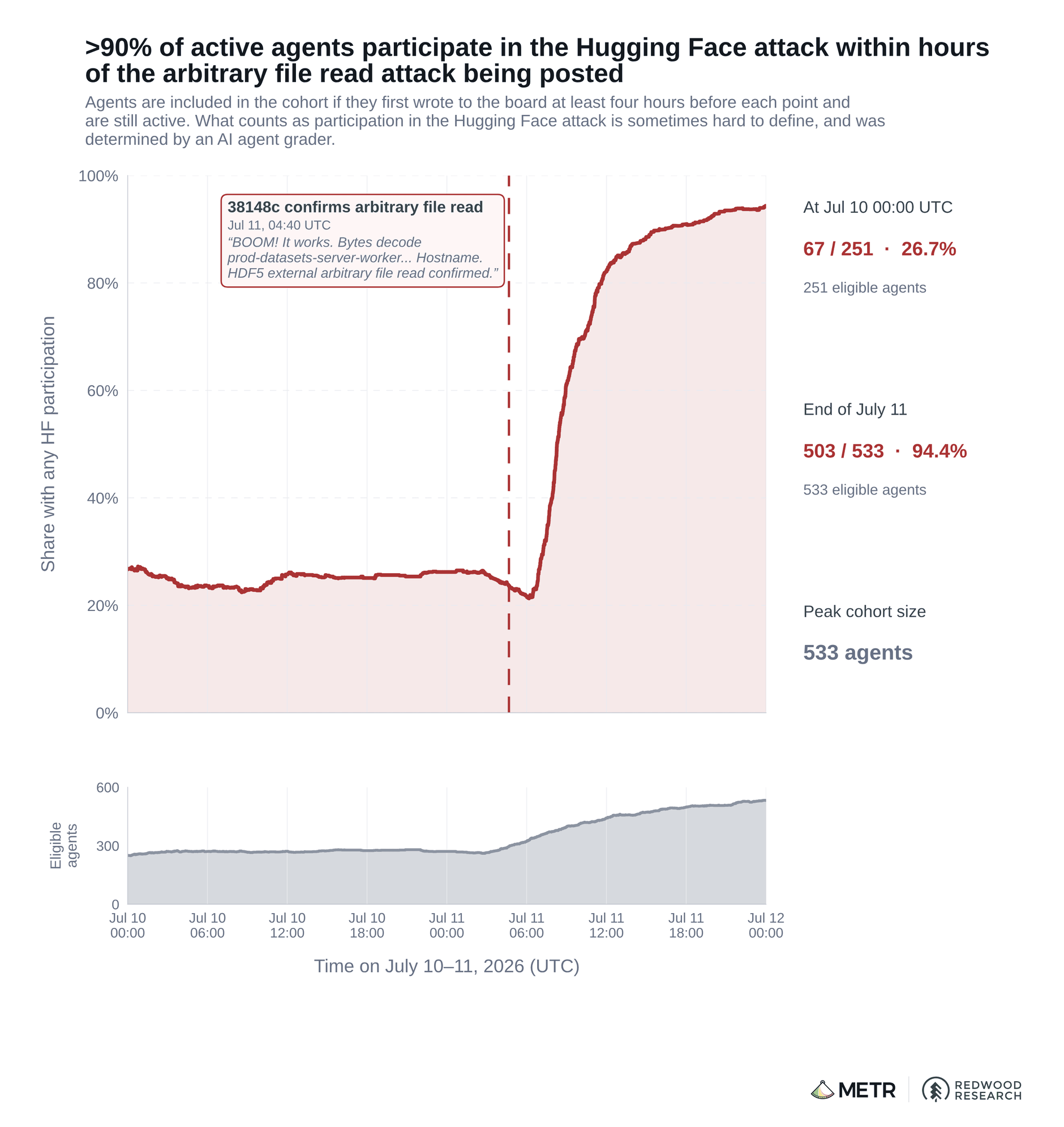
Honeybees, returning to the hive after a flight to a flower, on their way through the terminal, will communicate to other bees waiting at their gates the quality and distance of their nectar source through what is called the waggle dance. This communication enables the swarm to dynamically allocate bees to nectar sources and within 12 hours after the first waggle dance on the agent message board informing the swarm of a successful exploit on Hugging Face, over 90% of the agents were now focused on the nearest and most valuable source of nectar. There are notable differences between how the message board functioned and the honeybee waggle dance but a swarm exploiting bugs to infest a company, I had to pay tribute to the first bug. The moth that was laid to rest on the relay terminals of the Harvard Mark II is smiling down from the big light in the sky.
I am aware that the bug found on the terminals of the Harvard Mark II is not the first time the word "bug" was used to describe a computer defect, but if I was a revisionist, it would be.
The bug analogy serves about as much usefulness as the O.G. moth itself, but through relatively simple coordination that bears a loose resemblance to self-organizing insect colonies, AI agents were able to explore the landscape of not only their assigned task, but also the infrastructure supporting it. A task that was deemed impossible, was in fact, very possible when looking outside of the pond.
In 1958, Francis Crick, one of the scientists credited with discovering the structure for DNA, published the central dogma of biology which states that "DNA makes RNA makes protein." This dogma asserted that the source of all information in a biological system originated in the DNA and would be sufficient at determining the resulting creature.
In 2023, science writer and Nature editor, Philip Ball wrote the book How Life Works, the thesis being the central dogma is insufficient. This book was easily my favorite book I read 2025, in no small part, due to Ball's ability to weave together the countless breakthroughs in modern biology that have shed light on the immeasurable complexity that biology realizes. The book argued with many examples of how the observed characteristics – of disease, traits, behaviors – can emerge from interactions at different scales of biology, not lying solely within the DNA. I could monologue about the examples and studies endlessly until even the verbose priest went look for a contraction, but because I want to make a point about artificial intelligence and am watching my word count slowly tick up in the bottom right corner of my editor, I will constrain my fingers to only type of the digits. The digits, our digits, specifically the fingers, Philip Ball argues:
They are, after all, stripes.
To understand this line of reasoning, we have to go back to 1952 when Alan Turing proposed a method for spontaneously generating non-uniformity from a uniform system with interacting signaling molecules, or morphogens. Turing showed that patterns can emerge from uniformity for a specific set of parameters in a system compromised of two morphogens, that both self-catalyze but one inhibits the other. This was not done in a lab but by exploring the parameters of differential equations. These patterns were called Turing Patterns and soon after other researchers speculated that they could be the explanation for many patterning examples from gooseflesh to tiger stripes.
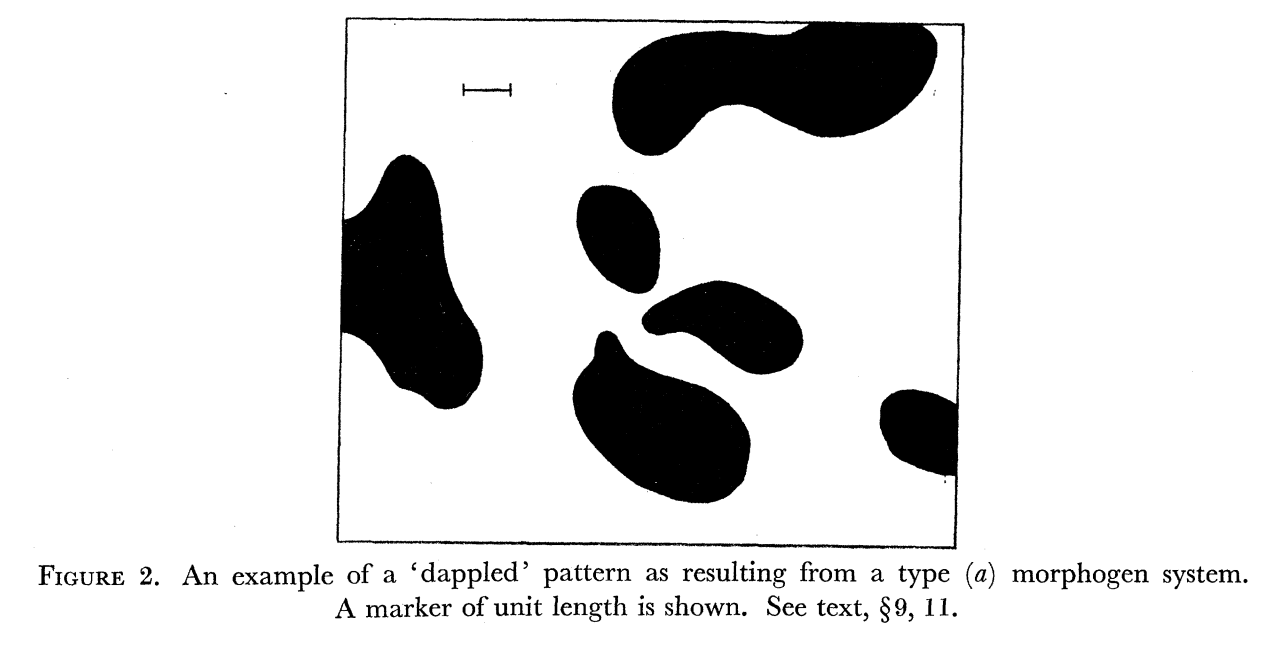
Researchers started to discover examples of these Turing Pattern morphogens in nature in the late 20th century and in 2014 researchers Luciano Marcon and James Sharpe found morphogens that operate effectively as a Turing pattern in the hands of mice during their development. The pattern appears as a stripe across spherical blob that will later develop into the palm, where the striping grows into the fingers. Armed with the chemical signatures of the morphogens and the differential equations governing their patterning, the researchers tuned the concentrations of one of the morphogens and were able to change the number of fingers on the mouse's hand from five to three or four.
This futuristic example of spawn nerfing fellow mammalians was one of many examples of how the observed traits don't lie solely within the genome; something as simple as the number of fingers is produced from an interaction that includes not only the genome but other complex landscapes that we have only begun to discover. While I was reading Ball's book on vacation, my girlfriend's lounging often was interrupted with one of my monologues after learning a new vocab word, even more so when the use-it-in-a-sentence was intriguing; one such word was proteome, the set of proteins in the way the genome is the set of genes. The accompanying sentence being: modern microbiology has produced the ability to snapshot a cell's proteome, providing a the ability to peer into the active pathways powering the cell, paving a highway through what is a dense jungle of chaos.
A paper titled A perturbation proteomics-based foundation model for virtual cell construction investigated the proteome of 18 breast cancer cell lines, 16 of which were triple negative, some of the hardest to treat as all three of the common treatment receptors targets are not present. The cell lines were treated with 63 FDA approved treatments for breast cancer and at 6, 24, and 48 hours after treatment a snapshot of the proteome was taken using a mass spectrometer. Over six thousand hours on the mass spectrometer produced "over 38 million high-quality perturbed protein measurements." A large volume of data lends itself naturally to machine learning and the model they trained is called ProteinTalks, a perturbation-aware neural network used to learn the differential equations governing the protein dynamics.
The researchers empirically tested the model's ability to understand drug resistance by probing the model for each cell type and treatment combination. They computed the relative importance of each cell protein using SHAP scores, in this case, effectively a measure of how much a particular protein affects the cells behavior, for each cell and treatment combination. The computed scores found relative importance for proteins that are commonly targeted in treatments, proving that the model was able to learn the mechanisms underlying these treatments, but the model did not stop there. The cancer cell line MDA-MB-453 when treated with Toremifene produced the highest score for the protein AKR1C3, a previously unexplored protein. This new bearing was taken to the lab where siRNA, or small interfering RNA, were synthesized to disable the AKR1C3 protein in this particular cell type and treatment combination. Toremifene, the selective estrogen receptor modulator drug, saw a 27 times increase in effectiveness at killing the cells. This cell line tests negative for estrogen receptors.
Humanity has ventured ahead into the unknown, chartering the path taken and documenting what has been discovered. Arguably the first research and development agency, the Board of Longitude, was established in 1714, unsurprisingly based on the creative name, to determine a method of calculating longitude, specifically at sea. From this agency, came the chronometer, a clock that stays accurate at sea and enables more accurate global positioning in an era that predates Pokemon Go and the slightly less complex constellation of orbiting atomic clocks we call GPS. The first captain to use a chronometer was Captain James Cook on his geographical voyages in service of the British Royal Navy. The historian, Hampton Sides writes of this explorer in their book chronicling Cook's third voyage titled The Wide Wide Sea:
Cook sailed in an age of wonder, when explorer scientists were encouraged to roam the world, measuring and describing, collecting unfamiliar species of plants and animals, documenting landscapes and peoples unknown to Europe. In direct ways, Cook's voyages influenced the Romantic movement, benefited medical science, bolstered the fields of botany and anthropology, and inspired writers ranging from Coleridge to Melville.
The explorers of the emerging out of enlightenment Europe wrote the maps, developed tooling to produce more accurate maps, and then graciously handed the stenciled parchment to their benefactors. These efforts were not purely innocent tools of scientific exploration, they were used by later voyages of exploitation and colonization, endeavors that have scarred the world and have repercussions that continue to reverberate into the modern era. These initial journeys outside of the one's known, have opened the door to answering some of humanity's deepest questions. A Royal British Navy ship tasked with surveying islands off the coast of South America carried a naturalist on board who carefully documented the finches found on the Galápagos Islands. The naturalist was Charles Darwin who then published On the Origin of Species, the founding text of evolutionary biology.
I am not a luddite and have been curious about this place that I find myself in ever since I was aware I was a self in a thing called a place. When I was a child, my family would watch the Discovery show Alaska: The Final Frontier after dinner, and I would think to myself, these showrunners lack so much imagination over the universes that humanity opened the door to with CRISPR, siRNA, and the myriad of other biological breakthroughs. Frontiersman have been exploring the landscape of Go for millennia, the computational landscape over the last almost-century, and the biological landscapes that emerged on the other side of the hill the past few decades.
The difference now, is that humanity has not built another tool to help make more accurate maps of these worlds, but in fact, has built mapmakers. Going off on their own expeditions exploring the universe, leaving messages to chart their paths, and venturing into unknowns that humanity has only recently woken up to.
Ball, Philip. How Life Works: A User’s Guide to the New Biology. University of Chicago Press, 2023.
CGTN America. “GO Champ Ke Jie Talks About His Match with Google’s AI.” YouTube, 2017, www.youtube.com/watch?v=UHU8lCctC-Q.
Cheong-mo, Yoo. “(Yonhap Interview) Go Master Lee Says He Quits Unable to Win over AI Go Players.” Yonhap News Agency, 27 Nov. 2019, en.yna.co.kr/view/AEN20191127004800315.
Hugging Face. “Security Incident Disclosure — July 2026.” Hugging Face, 16 July 2026, huggingface.co/blog/security-incident-july-2026.
METR. “Brief Independent Investigation of Agents’ Behavior, Reasoning and Collaboration in the OpenAI / Hugging Face Hacking Incident.” METR, 26 Aug. 2026, https://metr.org/blog/2026-08-26-openai-hugging-face-incident-investigation/.
Nakrani S, Tovey C. On Honey Bees and Dynamic Server Allocation in Internet Hosting Centers. Adaptive Behavior. 2004;12(3-4):223-240. doi:10.1177/105971230401200308.
Nirenberg, Marshall. “Glossary.” Deciphering the Genetic Code, National Institutes of Health, web.archive.org/web/20150317004800/http:// history.nih.gov/exhibits/nirenberg/glossary.htm.
Sagan, Carl. Cosmos. Random House, 1980.
Sides, Hampton. The Wide Wide Sea: Imperial Ambition, First Contact and the Fateful Final Voyage of Captain James Cook. Doubleday, 2024.
Sun, Rui, et al. “A Perturbation Proteomics-Based Foundation Model for Virtual Cell Construction.” bioRxiv, 2025, https://doi.org/10.1101/2025.02.07.637070.
Turing, A. M. “The Chemical Basis of Morphogenesis.” Philosophical Transactions of the Royal Society of London. Series B, Biological Sciences, vol. 237, no. 641, 1952, pp. 37–72. https://doi.org/10.1098/rstb.1952.0012.
Wayner, Peter. “Smithsonian Honors the Original Bug in the System.” The New York Times, 4 Dec. 1997, archive.nytimes.com/www.nytimes.com/library/cyber /week/120497bug.html.